
Demystifying Fats
This simple breakdown of fats will help you decipher which fats to use in which situations and why it matters.

On my Mind This Week
Both this week and next week’s newsletters will look a little different. After a long week of moving into our new house, I’m ready for a vacation and thankfully we had one on the books! As this lands in your inbox, I will be in flight to Germany, with my oldest son, to meet up with my youngest son and husband who have been there for a week for soccer camp. After watching some soccer, the four of us will head to the Swiss Alps where we will do a 4 day hut trek…I cannot wait!
So while I’m gone, Id like to share two articles that I previously published on my website’s blog. These are more researched pieces that focus on elements of holistic nutrition that I believe are important. Going forward, I’d love to include articles like this once a month or so if you find them interesting and helpful.
Understanding Fats

The inclusion of good fats in our diet is essential for overall health and longevity. But the wide array of fats available to us, along with a constant barrage of conflicting information is overwhelming. I’d like to provide a simple overview of fats and which ones to focus on when cooking, baking and snacking.
There are four broad categories of fats; saturated, monounsaturated, polyunsaturated, and trans fats. For those of us between 30 and 75, we were taught that saturated fats were the enemy. With this information came the increased popularity of highly processed industrial seed oils (a category of polyunsaturated fats) that can be argued to have had a more detrimental effect on our health than saturated fat. These oils include canola, corn, cottonseed, safflower, sunflower, peanut, and soybean. In general, they are the yellow oils you find in large plastic bottles. Margarine and Crisco are the other highly processed fats that should be avoided. These oils are processed from seeds that are often harvested from genetically modified and highly chemically treated mono crops. They are heated to extreme temperatures, making them unstable and likely to oxidize, creating free radicals. Additionally they are high in Omega-6 fatty acids, which will be discussed in more detail below. The addition of these oils to almost all packaged foods means that our consumption of them is significantly higher than you might assume. The next time you are in the store and buying packaged snacks, try to find one that doesn’t have one of these oils listed as an ingredient. I have found it extremely challenging and while I would prefer to avoid them, I also feel the need to provide a balanced household so we do have snacks with seed oils in our home.
I will return to polyunsaturated fats (PUFA’s), but lets get back to saturated and monounsaturated. Saturated fats from high quality sources, such as grass fed beef, wild game, organic, cold pressed coconut oil, butter and ghee from grass fed animals and even lard and tallow from grass fed animals are good choices, especially for high heat cooking. These fats are extremely stable, easily converted to energy, and loaded with antioxidants.
Monounsaturated fats (MUFA’s), such as olive oil, avocado oil and some nut oils have been proven over and over to contribute to healthy diet, but be sure to find the ones that are cold pressed, unrefined and sold in dark bottles. Keep these oils away from heat and light when storing, in order to avoid oxidation. They can be used for medium heat cooking and baking, but should be avoided for high heat cooking and broiling.
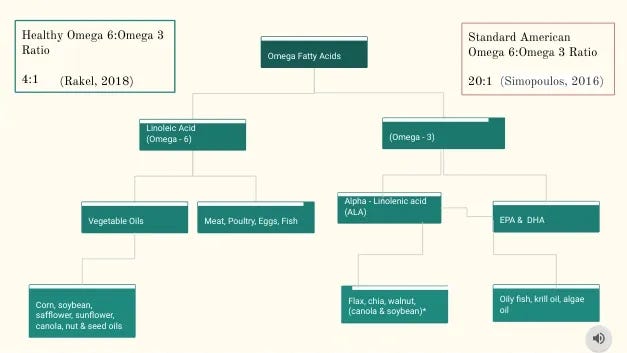
Omega fatty acids are a required component of our diet because we cannot synthesize them from anything else, but the ratio of Omega-6 fatty acids to Omega-3 fatty acids is critical in the battle against chronic inflammation and possibly a much wider array of chronic medical problems. The recommended ratio is 4:1 of Omega 6 to Omega 3, but studies have shown that many Americans consume a ratio closer to 20:1. Omega 6 fatty acids are found in red meat, poultry, eggs, nuts, seeds and the industrial seed oils mentioned earlier. Omega 3 fatty acids are found in much more limited foods such as deep water fish, krill, flax seeds, chia seeds, walnuts, soybeans* and rapeseeds*(the seed for canola oil). Unfortunately soybean and canola oils are not good sources of Omega-3 fatty acids due to their industrialized processing for use by big food companies.
Trans fats are generally known to be detrimental to our health, but food labeling does not always give us the information we need to avoid them. It is not necessary to list trans fats on a label if the serving has less than .5 grams of trans fat. For this reason, always look ‘partially hydrogenated’ in the ingredient list. While hydrogenated oils have had the trans fat removed, they are still a highly processed fat that should be avoided as often as possible.
It’s important to remember that while fats are important for our overall health, over consumption of fat can lead to unwanted weight gain. With this in mind, I try to encourage people not to fear fat, but to understand the fats they are consuming and to consume them in moderation as you should most anything! The two links below are to blog posts that go further in depth on this topic, but also are easy to read and understand.
https://pamela-grant.com/blog-ss/know-your-fats
https://chriskresser.com/how-industrial-seed-oils-are-making-us-sick/
Let me know if you would want more of this content!
References
Ananth, D. et al. (2019). Phytochemical composition and antioxidant characteristics of traditional cold pressed seed oils in South India, Biocatalysis and Agricultural Biotechnology, Volume 17, Pages 416-421, https://doi.org/10.1016/j.bcab.2018.12.018.
Rakel, D. (2017). Integrative medicine (4th ed). New York: Saunders.
Simopoulos A. P. (2016). An Increase in the Omega-6/Omega-3 Fatty Acid Ratio Increases the Risk for Obesity. Nutrients, 8(3), 128. https://doi.org/10.3390/nu8030128
Holistic Wellness
Holistic wellness encompasses every aspect of life that affects our daily health and the pursuit of optimal longevity. Mental, physical, and environmental factors contribute to how we feel, how we see the world around us, and how we move into the future. I’m a firm believer that a life of moderation is key to overall wellness and that no idea, single path, or diet is meant to consume us. Be open to trying new things, varying your routine, and listening to what others have to share, even if you’re not sure you agree.
Lifestyle
Making a habit of reading the back of a product package is a habit that will benefit you for years to come. While I’d love to give you my tips here, I feel that directing you to Mira Dessy is an even better options as she specializes in this. Her book, The Pantry Principle: how to read the label and understand what’s really in your food, is an incredible resource.
Fitness
No tips this week. Go take a hike!
Nutrition
This week’s quick tips:
Use coconut oil, beef tallow, ghee or butter for high heat cooking
Use olive oil and nut oils for salad dressings and low heat cooking
Eat fish
Limit consumption of processed snacks, especially those containing seed oils
Kitchen Realities
Complete chaos. For the duration of moving week, I generally subsisted on hard boiled eggs for breakfast, trail mix, nuts, and cheese throughout the day and either local restaurant pick up or eat in for dinner. I did make some ground elk one night which I ate over some leftover lettuce.
Garden Updates
Absolutely no idea what is happening in the garden as I haven’t had time to get over there…cue my sad face.
Welcome to Table Root Farm

Table Root Farm is a physical place that holds a large garden, a handful of chickens, a charming AirBnb, and a unique ability to melt away the stresses of daily life. For this reason, it’s also the virtual place that hosts my newsletter, my social media platforms, and my musings.
My name is Kalee Tilli and I’m a Holistic Nutritionist, living and learning in a North Atlanta suburb. My heart lives in the mountains of Colorado, but for now, my two teenage sons, husband and I are exploring life as southerners. I teach cooking classes focusing on local, seasonal produce, while trying to remind myself and my clients that guilt has no place at the table. There are many seasons of our lives and most will not include eating a diet of exclusively home prepared, seasonal and local foods. My newsletter aims to share a bit of whatever is on my mind, Holistic Wellness tips, Recipes, and recommendations.
I hope you are having the BEST time! And, even though trips abroad aren't always relaxing (or meant to be), I hope this one feels rejuvenating.
Great info. Thanks